
Speculation stages a set of references around the afterlife of bohemianism, artistic precarity, and the conversion of images into assets. Van Gogh's bedroom has become both an image of artistic life and an object of speculation. The 'Yellow House' at Arles (shown here in a sparse monochrome) was a failed attempt to create a communal living situation for artists de-centered from the Parisian sphere of influence. Strindberg's The Red Room, canonised as a foundational text in Scandinavian modernism, satirises the hypocrisy of Stockholm society from a bohemian perspective.
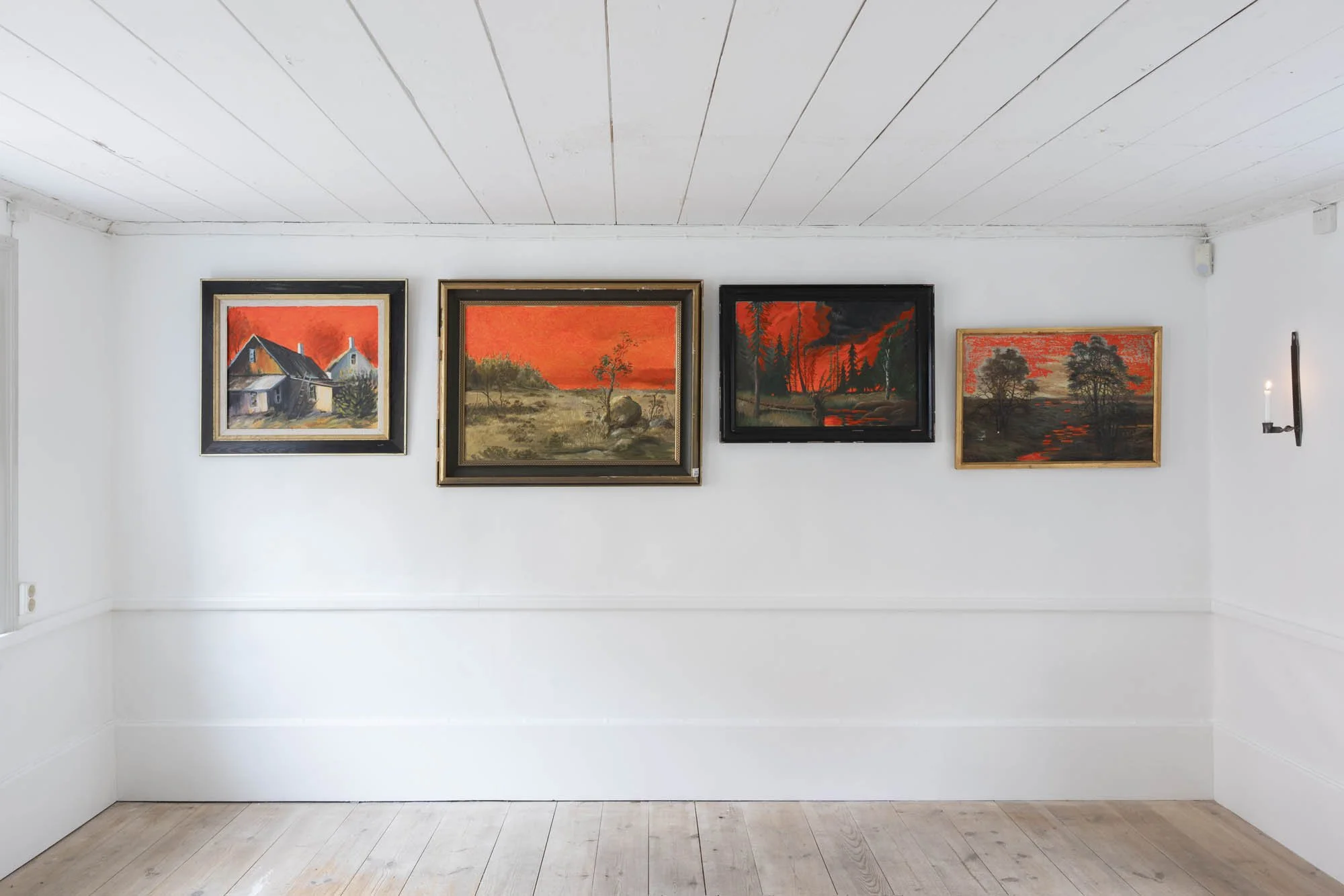
As the protagonist moves through the social strata of Stockholm he finds himself outside the gallery in Vita Bergen, then housing a destitute family on the outskirts of Stockholm. For reasons at once geographical, political, racial and historical, Stockholm is one of the most segregated cities in the Nordic region. Södermalm, no longer at the edges of the city, but a center for the new creative middle class and entrepreneurs, remnants of its history are used to flavour menus, boutiques, and rental prices. Together with an image of the building in 1910, the works point to the way signs of modest life and artistic marginality are reproduced long after the material conditions they refer to have been incorporated into property, social and cultural capital. The work Burn Rate consists of a number of détourned paintings found in second hand stores in the vicinity of the gallery, presented as a 19th century salon hang, where the pictorial horizon, now ominously orange, is used to center the visual field. In today's Södermalm, Speculation reflects on how these images continue to circulate as atmospheres, narratives and assets. Materials treated not as singular artworks than as elements in a situation. They move between painting, photography, literature, display, to an expanded concept of site."